
A recent release, Dhurandhar, directed by Aditya Dhar, has taken Bollywood’s spy-thriller genre to a new level. Inspired by real events, the film has been widely appreciated not only in India but also in Pakistan. However, amid the praise, YouTuber Dhruv Rathee labelled Dhurandhar a “propaganda film,” while calling Yash Raj Films’ spy universe “brilliant.”
The implication was clear: films that portray Pakistan or the ISI in a positive light—often while casting Indian intelligence agencies or the Indian Army in a negative role—are being celebrated as nuanced and progressive. This has reignited a long-standing debate: is this merely coincidence, or is Bollywood gradually constructing a new narrative?
Over the past few years, several big-budget films and web series have shown a striking pattern—the villain turns out to be Indian, while Pakistani or ISI-linked characters are portrayed as rational, ethical, and cooperative. The question is not just what these films show, but why the same direction is being repeated so consistently. Here’s a closer look at films and series that exemplify this trend.
Main Hoon Na (2004): An Indian as the Enemy of Peace
Farah Khan’s 2004 blockbuster Main Hoon Na, starring Shah Rukh Khan, sits at the top of this list. Set against the backdrop of India–Pakistan peace talks, audiences naturally expect an external threat. Instead, the film takes a sharp turn—the terrorist is not Pakistani, but an Indian former army officer, Raghavan, who considers peace a betrayal of the nation. In contrast, Pakistani military officials are depicted as sensible and cooperative.
Question: Did this film plant the idea that the biggest enemy of peace lies within India itself?
Ek Tha Tiger (2012): An ISI Agent as a Mainstream Heroine
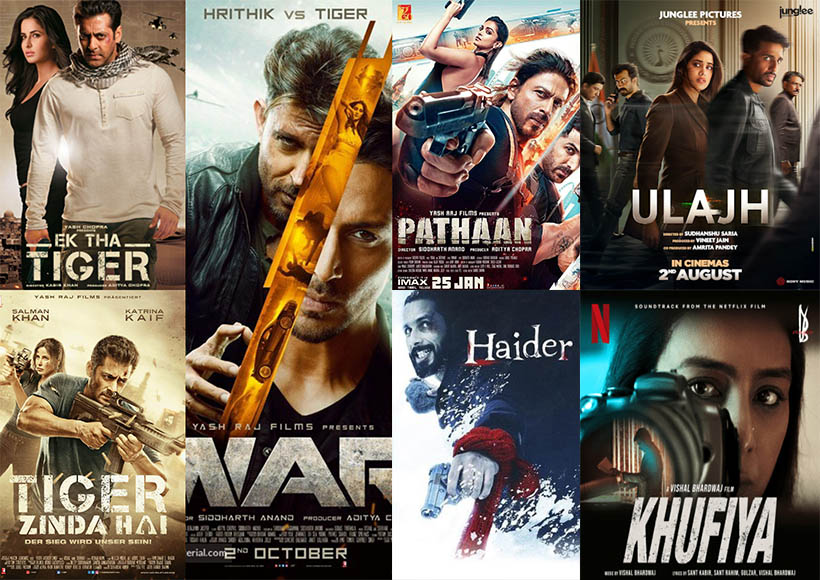
Kabir Khan’s Ek Tha Tiger, Yash Raj Films’ first major spy thriller, marked a turning point. For the first time in mainstream cinema, an ISI agent—Zoya, played by Katrina Kaif—was portrayed not just positively, but as a romantic heroine. Meanwhile, India’s RAW was shown as a system capable of betraying its own agents.
A serious question: Was this merely a love story, or an attempt to “humanise” and brand the ISI as trustworthy?
Tiger Zinda Hai (2017): RAW–ISI Brotherhood
In Tiger Zinda Hai, directed by Ali Abbas Zafar, the primary enemy is a terrorist organisation. Yet the film’s strongest message is that RAW and ISI must work together to save the world. ISI officers are shown as professional, dependable, and morally sound.
Criticism: Is this cooperation harmless fiction, or a cinematic effort to gradually reprogram audience perceptions?
War (2019): A Traitor Within RAW
Siddharth Anand’s War, starring Hrithik Roshan and Tiger Shroff, delivers a clear message—the danger lies not outside India, but within RAW itself. The antagonist is an Indian agent who places himself above the system. Pakistan is pushed entirely into the background.
Question: Is this another step toward portraying Indian agencies as inherently unreliable?
Pathaan (2023): Villain from RAW, Trust from ISI
Pathaan represents the peak of this trend. The main villain, Jim, is a former RAW agent who turns against the country. In contrast, the ISI agent Rubai is shown as strong, ethical, and ultimately a key ally of the hero. The RAW–ISI partnership is portrayed as essential for “global good.”
Direct question: Was this the first mainstream blockbuster to present a rogue Indian intelligence officer as the greatest threat?
Haider (2014): The Army and the System in the Dock
Vishal Bhardwaj’s Haider, set in Kashmir, places Indian security forces and the intelligence system under scrutiny. The Indian establishment is depicted as harsh and inhuman, while Pakistan is not directly positioned as the villain.
Controversy: A human story—or a one-sided political perspective?
Khufiya (2023): Traitors Within RAW
In Bhardwaj’s spy series Khufiya, the central message is explicit: India’s biggest problem is not external enemies, but insiders. ISI officers are portrayed as calm, balanced, and strategic.
Question: A spy thriller—or a narrative that breeds distrust in institutions?
Bard of Blood (2019): Failure of the Indian System
The Emraan Hashmi–led web series Bard of Blood also fits this pattern. It focuses on flawed policies and internal politics within Indian intelligence agencies. ISI officers are again not shown as outright villains.
Ulajh (2024): Questioning the System Under the Guise of Patriotism
Janhvi Kapoor’s Ulajh initially appears to be a patriotic diplomatic thriller. But as the story unfolds, the core crisis emerges from within India’s own system—internal power centres, conspiracies, and institutional weaknesses. External enemies remain secondary, while Pakistan-linked characters are not openly villainised.
This mirrors the pattern seen in Pathaan, Khufiya, and War: the threat is internal, not external. Critics see this as the next stage of “narrative engineering”—it’s no longer necessary to glorify Pakistan; consistently portraying Indian institutions as suspect is enough.
The Bigger Question: Why This Trend?
Film experts argue that this shift is driven by the need to appeal to global markets, promoting a “no nation, only humanity” worldview and redefining patriotism. Critics, however, contend that the repeated portrayal of Indian institutions as dubious—while softening the image of the ISI—creates a one-sided narrative that shapes public perception over time.
Conclusion: Coincidence or Strategy?
One or two films could be dismissed as coincidence. But when Indian villains and positive Pakistani or ISI-linked characters appear repeatedly, the questions become unavoidable. Cinema is entertainment—but it also shapes thought.
The final judgment rests with the audience: is this merely storytelling, or a gradual attempt to steer perception in a particular direction?